

Why Some Brands Connect With Customers and Others Do Not
Two businesses can sell a similar product at a similar price, with equally polished logos, and one will feel familiar and trusted while the other stays forgettable. The gap rarely comes from design quality or advertising spend alone. It comes from whether the brand means something specific to a specific group of people.
A logo is a signal, and advertising is a megaphone. Neither creates meaning. Meaning comes from a chain of decisions: what the business is trying to achieve, who it serves, what those people need, how the brand should be perceived, and how that perception is delivered at every point where a customer meets the brand.
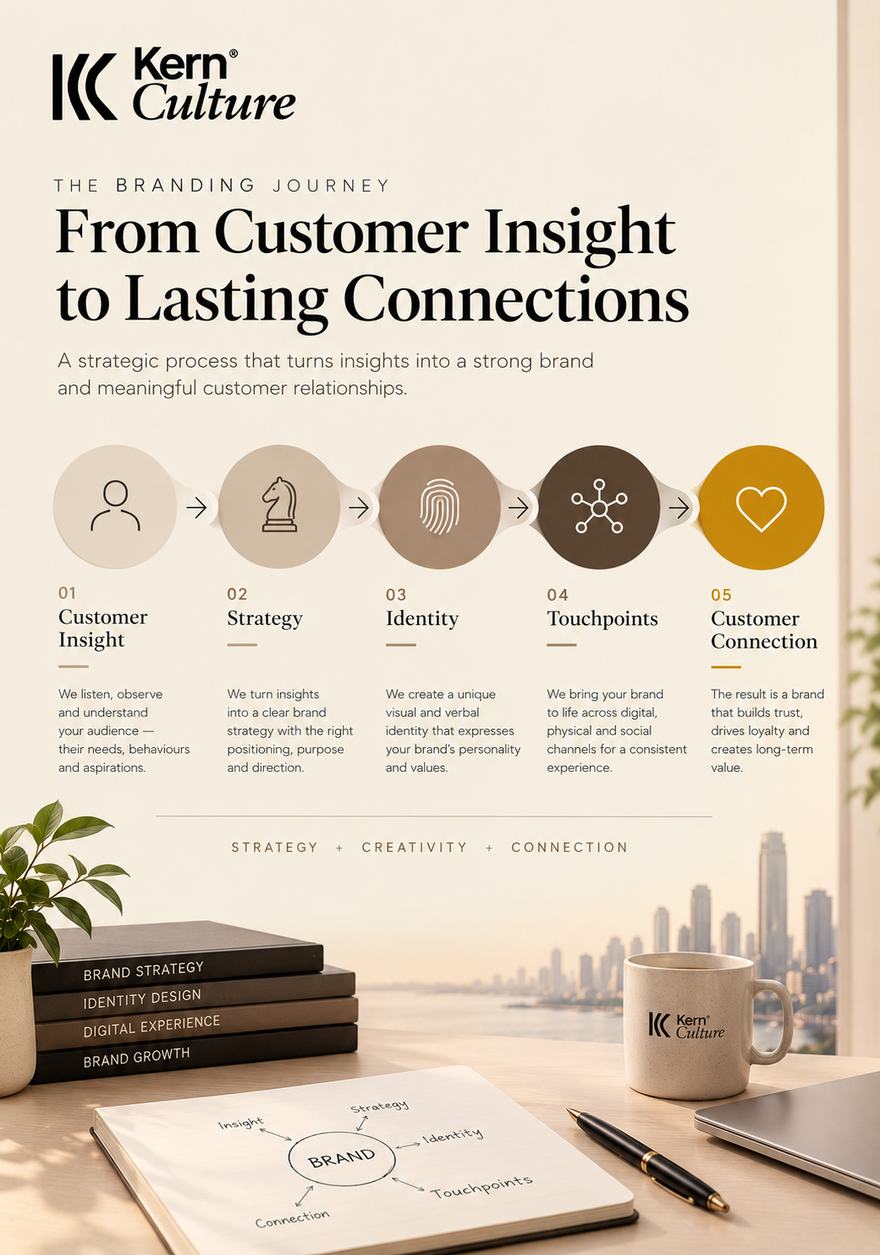
This is the work a good branding agency does. Branding agencies build brands that connect with customers by working through that chain in order: business understanding, customer understanding, brand strategy, positioning, differentiation, messaging, identity and experience. This guide explains each link in the chain, shows how it worked in a real project, and offers a practical way to evaluate an agency before you hire one.
What Does It Mean for a Brand to Connect With Customers?
A brand connects with customers when the right people recognise it, understand what it stands for, trust it, and see it as relevant to their own needs and values. Connection is a state of customer perception, and it is earned through consistent experience rather than declared in a tagline.
Several qualities make up that connection:
- Relevance: the brand addresses something the customer actually cares about.
- Recognition: the customer can identify the brand quickly across touchpoints.
- Trust: what the brand promises matches what the customer experiences.
- Differentiation: the customer can tell why this brand is not interchangeable with another.
- Meaning: the brand stands for something beyond the transaction.
- Consistency: the brand behaves coherently over time and across channels.
Notice that every item on this list lives in the customer’s mind. Customer perception is the real measure of branding, which is why a branding agency spends so much effort before any design begins.
Why Customer Understanding Comes Before Brand Design
Most weak branding starts with a visual brief (“we need a modern logo”) rather than a customer question. Design applied before understanding produces work that looks professional but says nothing in particular.
Customer understanding means more than demographics. A branding agency typically looks at:
- Customer needs: the functional and emotional problems the customer wants solved.
- Motivations: why the customer cares enough to act.
- Expectations: what the customer assumes a brand in this category will deliver.
- Behaviour: how the customer searches, compares, buys and recommends.
- Pain points: where existing options frustrate or disappoint.
- Decision-making: who is involved, what they weigh, and what tips the choice.
- Existing perceptions: what the customer already believes about the business or its category.
The last point matters more than it first appears. Customers rarely meet a brand as a blank slate. They arrive with category assumptions, and effective branding either works with those assumptions or deliberately breaks them. Without this understanding, visual execution is guesswork.
How Branding Agencies Understand the Business Behind the Brand
A brand has to be built on a real business. Before looking outward, a branding agency looks inward, usually through conversations with founders and leadership. The areas explored typically include:
- Business model: how the company makes money and what drives its economics.
- Founder vision: why the business exists and where the founder wants it to go.
- Business objectives: growth, entry into new markets, premium positioning, investment readiness, or something else.
- Products and services: what is actually offered and what is genuinely strong.
- Growth ambitions: the scale and pace the brand must support.
- Existing perception: how customers, partners and the team currently describe the business.
- Business challenges: the commercial problem that branding is expected to help solve.
Founders often hold several partly conflicting ambitions at once. They want to be premium and accessible, or innovative and familiar. Surfacing these tensions early is one of the most useful things an agency does, because a brand cannot be everything and the strategy has to make choices.
How Branding Agencies Study the Competitive Landscape
No brand is perceived in isolation. Customers compare, so a branding agency studies the competitive landscape to understand what the brand is being compared against. This usually covers:
- Direct competitors: businesses offering a similar solution to the same customer.
- Indirect competitors: alternatives that solve the same need differently, including doing nothing.
- Category conventions: the shared codes of a category, such as colours, tones and claims that everyone uses.
- Competitor positioning: what each player claims to stand for.
- Visual and messaging patterns: where the category looks and sounds alike.
- Market gaps: meaningful territory no one is occupying credibly.
- Customer expectations: what the category has trained customers to expect.
The aim is not to copy or to be contrarian. The aim is to see clearly where a brand would blend in, and where a distinct and relevant position might exist. In crowded Indian categories, where many D2C brands launch with near-identical visual codes, this analysis often decides whether a brand is noticed at all.
How Branding Agencies Identify What Customers Really Need
Understanding customers is not a single insight but a sequence. Branding agencies commonly work through it like this:
Customer Need → Motivation → Perception → Expectation → Decision → Experience
- Need: what problem or desire exists.
- Motivation: why it matters to this person now.
- Perception: how the person currently sees the category and available brands.
- Expectation: what they assume a good option will look and feel like.
- Decision: what ultimately makes them choose.
- Experience: what happens after the choice, which determines whether the brand earns loyalty.
Each stage informs a different strategic decision. Needs shape the value proposition. Perception and expectation shape positioning, because they show what must be reinforced and what must be challenged. Decision factors shape messaging priority. Experience shapes the brand’s touchpoints. A brand built without this sequence tends to answer questions customers are not asking.
How Branding Agencies Define Brand Positioning
Brand positioning is the deliberate decision about where a brand sits in the customer’s mind relative to alternatives. A branding agency typically resolves six questions:
- What the brand stands for: its purpose and core idea.
- Who it is for: the specific target audience, including who it is not for.
- What category it belongs to: the frame of reference that tells customers how to understand it.
- What makes it different: the basis of differentiation.
- Why customers should care: the value proposition and the benefit that matters.
- How it should be perceived: the associations the brand wants to own.
A positioning that cannot be stated plainly is usually not yet a positioning. Teams sometimes confuse positioning with a tagline, but a tagline is only one possible expression of it. For a deeper look at the discipline, see Kern Culture’s resource on brand positioning. This article focuses instead on how positioning fits into the wider customer-connection process.
How Brand Differentiation Helps Customers Choose a Brand
There is a difference between being different and being meaningfully different. Any brand can be different by choosing an unusual colour or an odd name. Meaningful differentiation gives customers a reason to prefer the brand that they care about and can believe.
Differentiation can work on several levels:
- Functional differentiation: the product or service does something better or differently.
- Emotional differentiation: the brand makes people feel something the alternatives do not.
- Experiential differentiation: the way the brand is encountered, purchased or used is distinct.
- Cultural relevance: the brand connects to a belief, identity or cultural moment the audience shares.
- Perceived value: the brand shapes how worthwhile the offer feels, independent of its specification.
In categories where products are close to identical, functional differences are easy to copy, so emotional and cultural differentiation often carry more weight. The test is simple. If a competitor could adopt the same claim tomorrow with no change to their business, it is not strong differentiation.
How Branding Agencies Develop Brand Messaging
Brand messaging is where strategy becomes language. A branding agency translates positioning into a structure that the whole organisation can use. Common components include:
- Brand narrative: the story of why the brand exists and what it believes.
- Value proposition: the specific benefit offered to a specific customer.
- Key messages: the few ideas the brand wants customers to remember.
- Brand voice: the consistent personality of the brand’s language.
- Tone of voice: how that voice flexes for different situations, such as a product page versus an apology.
- Messaging hierarchy: which messages lead, which support, and which are used only when needed.
- Customer-facing communication: how all of this appears in real copy across channels.
A messaging framework matters because most brand communication is written by many people over many years. Without a shared framework, each writer improvises, and the brand slowly loses coherence.
How Branding Agencies Turn Strategy Into Brand Identity
Brand identity is the sensory expression of the brand. A branding agency develops it through brand identity design, which usually includes:
- Logo: the primary mark and its variations.
- Typography: the typefaces that give the brand its visual voice.
- Colour system: the palette and the rules for using it.
- Photography and imagery: the style and subject matter that feel like the brand.
- Graphic language: patterns, shapes and devices that extend the identity.
- Packaging: the physical expression, where relevant.
- Digital identity: how the brand adapts to screens, interfaces and social formats.
- Design systems: the reusable rules and components that keep everything coherent at scale.
The core principle is that brand identity should express the strategy, not replace it. When identity is designed first, the strategy is usually written afterwards to justify the visuals. When strategy leads, every design decision can be traced back to a reason, and the identity says something specific about what the brand stands for. This is also what makes design decisions easier to discuss: the question changes from “do we like it?” to “does it express the idea?”
How Brand Experience Shapes Customer Perception
Customers form perceptions through experience, not through brand documents. Brand experience is the sum of every brand touchpoint, and the relationship can be expressed as:
Brand Promise → Brand Expression → Customer Experience → Customer Perception
The promise is what the brand claims. The expression is how it communicates that promise. The customer experience is what actually happens. Perception is the conclusion the customer draws. If the experience contradicts the promise, perception follows the experience.
Touchpoints worth designing deliberately include:
- Website and digital experience: often the first serious encounter with a brand.
- Packaging experience: especially for physical products, where unboxing is part of the brand.
- Social media: where tone and consistency are tested daily.
- Sales experience: conversations, proposals and onboarding.
- Retail experience: physical environments and staff behaviour.
- Digital products: interface language, flows and notifications.
- Customer service: how problems are handled, which often shapes loyalty more than marketing does.
- Post-purchase communication: follow-up, support and community.
A branding agency maps the customer journey to find which touchpoints matter most and where the experience is likely to diverge from the promise.
Why Brand Consistency Builds Recognition and Trust
Brand recognition is built through repetition of a coherent signal, and trust is built when that signal proves reliable. Consistency applies across:
- Messaging: the same core ideas and voice.
- Visual identity: recognisable colours, typography and imagery.
- Customer touchpoints: a sense that the same brand is behind the website, the packaging and the support team.
- Digital channels: coherence between the website, social profiles and campaigns.
- Physical experiences: retail, events and printed material.
Consistency does not mean every touchpoint must look identical. A strong brand system defines what stays fixed and what is allowed to flex. A social post, a product label and a billboard can look different and still feel unmistakably like the same brand, because they share the same underlying logic. Brand guidelines exist to make that logic explicit so that teams and external partners can apply it without constant approval.
How Branding Agencies Adapt Brands to Changing Customer Expectations
Brands are not finished once launched. Customer expectations move, and a brand that was distinctive five years ago can become ordinary once the category catches up. Branding agencies help businesses watch for signals such as:
- Changing customer behaviour: new ways of researching, buying and sharing.
- Cultural shifts: changes in what audiences value or find credible.
- Digital experiences: rising expectations for speed, clarity and personalisation.
- New competitors: entrants that reset category norms.
- Category evolution: the category itself changing shape.
- Changing expectations: what customers once admired becoming what they simply assume.
Adaptation does not always mean a full rebrand. Often it means refining positioning, updating messaging or extending the design system while keeping the core recognisable. For businesses in the Indian market, where categories can change quickly as digital behaviour evolves, a periodic strategic review is often more valuable than waiting for a visible problem. Businesses looking for a partner with this national context can explore Kern Culture’s perspective on working as a branding agency in India.
Branding Agency vs Marketing Agency: What Is the Difference?
The two disciplines overlap, but they answer different questions.
Branding is concerned with:
- Meaning: what the business stands for.
- Positioning: where it sits relative to alternatives.
- Identity: how it looks and sounds.
- Perception: how customers understand it.
- Long-term brand direction.
Marketing is concerned with:
- Demand generation.
- Customer acquisition.
- Promotion and campaigns.
- Distribution and channel management.
Branding sets the direction, and marketing carries it to market. A strong brand makes marketing more efficient because campaigns have a clear idea to communicate. Marketing without a clear brand tends to compete on price and promotion because it has nothing distinctive to say. Many businesses need both, in sequence or in parallel, but they are different jobs and are often done best by teams with different strengths.
Branding Agency vs Creative Agency vs Design Agency
These labels are used loosely, and agencies often combine them, so the following is a general distinction rather than a rule.
- A branding agency typically starts with strategy: research, positioning, messaging and identity, and the system that holds them together.
- A creative agency typically focuses on ideas and campaigns, often producing advertising, content and communication concepts.
- A design agency typically focuses on visual and experiential execution, such as graphic design, digital interfaces, packaging and print.
A business searching for a creative agency in Mumbai or a design agency in Mumbai may be looking for execution capacity, while one searching for a branding agency is often looking for strategic clarity first. None of these is better in general. The right choice depends on the problem. If the business already has a clear strategy and needs strong execution, a design agency may be the right fit. If the strategy itself is unclear, execution alone may not fix the underlying problem. Some firms, including Kern Culture’s design agency in Mumbai offering, deliberately combine strategic and design work so that identity stays connected to the reasoning behind it.
When Should a Business Work With a Branding Agency?
Certain moments make the case for branding support stronger:
- Starting a new business: early decisions about name, positioning and identity are hard to reverse later.
- Entering a new market: a brand that worked in one market may not translate to another.
- Launching a new product: especially when it needs its own identity or sits within a larger brand architecture.
- Repositioning: when the business has changed but perception has not.
- Rebranding: when the existing identity no longer reflects the business.
- Rapid growth: when informal brand decisions stop scaling.
- Customer perception problems: when customers misunderstand or undervalue the business.
- Competitive pressure: when the brand is being absorbed into a crowded category.
- Inconsistent communication: when different teams present the business in different ways.
The common thread is a gap between how the business sees itself and how customers see it, or a decision point where that gap is about to become expensive.
What Should Businesses Expect From a Branding Agency?
The process varies between agencies, but a thorough engagement tends to follow a sequence like this:
Discovery → Strategy → Positioning → Messaging → Identity → Experience → Guidelines → Implementation
- Discovery: the agency learns the business, customers and competitive landscape. Everything later depends on its quality.
- Strategy: discovery is distilled into a clear direction, including purpose, audience and the central problem to solve.
- Positioning: the strategy is converted into a defined place in the customer’s mind.
- Messaging: the positioning is expressed in narrative, value proposition and voice.
- Identity: the strategy is given visual and sensory form.
- Experience: the brand is applied to touchpoints so that the promise can be delivered, not just described.
- Guidelines: the rules and reasoning are documented so the brand stays coherent as more people use it.
- Implementation: the brand is launched and rolled out, which is where theory meets operational reality.
The sequence matters because each stage constrains the next. Skipping discovery produces generic strategy, and skipping strategy produces decorative identity. A good agency can explain why each stage exists, and what you will have at the end of it that you did not have before.
Real Branding Example: Omara
The following is a first-hand example from Kern Culture’s own work. It describes the strategic reasoning behind the project and does not make claims about commercial results, since none are asserted here.
Omara is a fine jewellery brand.
The Challenge
Omara was a new fine jewellery brand entering a saturated category. In such categories, customers already hold strong expectations, and many established players communicate in similar ways. A new entrant has to earn attention without the history that established names rely on.
The Strategic Problem
Traditional luxury and beauty conventions did not create the distinction the brand needed. Following the category’s familiar codes would have placed Omara alongside existing options, where it would be compared on terms set by others. The problem was not a lack of quality or polish. It was the risk of being perceived as one more brand in a familiar pattern.
The Strategic Direction
The strategic move was to shift the conversation away from decoration and towards the idea of jewellery as personal triumph. Instead of positioning jewellery as something worn to be admired, the direction framed it as something worn to mark a personal achievement.
The Brand Idea
Adornment as victory.
This idea is concise enough to guide decisions and distinctive enough that it is not simply a restatement of category norms.
The Expression
The idea was carried through the brand’s logo, packaging, narrative, go-to-market approach and creative direction. The point of extending it across these areas is that the idea, rather than a set of visual preferences, became the reference for each decision.
The Learning
The project illustrates several principles discussed above. Meaningful differentiation came from a considered idea about what the product means to the wearer, not from a visual departure alone. Positioning set the direction first, and identity expressed it afterwards. And because the idea was clear, it could be applied consistently across very different touchpoints, from a logo to a go-to-market plan. It also shows why category conventions deserve scrutiny: following them is safe, but safety and distinction rarely coincide.
How Kern Culture Approaches Brand Building
Kern Culture is a strategic branding and design consultancy based in Mumbai. Its approach is organised around two complementary ideas, the Frame and the Flow.
The Frame
The Frame is the structural side of brand building. It includes:
- Brand strategy
- Positioning
- Structure
- Messaging
- Systems
- Consistency
The Frame gives the brand a stable foundation: what it stands for, how its parts relate, and what rules keep it coherent over time.
The Flow
The Flow is the living side. It recognises that brands exist in a moving environment, and it pays attention to:
- Customer behaviour
- Culture
- Market evolution
- Conversations
- Expectations
- Touchpoints
- Interpretation
The Flow is about how the brand is actually received, since customers interpret brands in ways that no framework can fully control.
How the Two Work Together
A brand with only a Frame can be rigorous but rigid, correct on paper and detached from how people actually behave. A brand with only a Flow can be responsive but incoherent, constantly reacting without a stable identity. Used together, the Frame provides the consistent core and the Flow keeps it relevant. The brand has something to hold onto while it adapts to changing customer expectations.
Why First-Hand Branding Experience Matters When Choosing an Agency
Branding looks orderly in a process diagram, and real projects are messier. Experience with actual projects tends to show up in how an agency handles:
- Strategic ambiguity: deciding when evidence is sufficient and when a judgement call is needed.
- Founder decisions: navigating strong personal views while keeping the work anchored in customer reality.
- Category complexity: understanding what is conventional, what is risky to break, and what is worth breaking.
- Customer perception: distinguishing what customers say from what actually shapes their choices.
- Implementation challenges: anticipating how a concept will behave once it meets budgets, vendors and production constraints.
- Maintaining consistency: designing systems that other people can apply correctly.
- Translating strategy into real-world touchpoints: making sure a positioning idea survives contact with packaging, websites and sales conversations.
The Omara example reflects this: the question was never only what the logo should look like, but how a single idea could remain intact across a logo, packaging, narrative and go-to-market approach. When evaluating any agency, ask to hear how decisions were made on real work, including trade-offs and constraints, not only to see finished outcomes.
How to Evaluate a Branding Agency
A useful evaluation looks beyond portfolios. Consider these ten areas:
- Strategic thinking: can the agency explain the problem before proposing a solution?
- Relevant experience: has it worked on challenges comparable to yours, in structure if not in sector?
- Discovery process: how does it learn about your business and customers before designing?
- Positioning capability: can it articulate a clear, defensible position, and show how it arrived there?
- Ability to explain decisions: can it connect each design choice to a strategic reason?
- Identity development: does the visual work express the strategy, or only look attractive?
- Brand systems: does it deliver flexible systems and guidelines, or only fixed assets?
- Implementation thinking: does it consider how the brand will be used day to day?
- Collaboration: how does it work with your team, and how does it handle disagreement?
- Long-term perspective: does it think about how the brand evolves, not just how it launches?
Treat these as questions to ask rather than a scoring formula. Whichever agency you consider, a professional branding agency should be comfortable explaining its reasoning in plain terms.
Brand-Building Checklist
Use this checklist to test whether your brand is built on a connected foundation:
- Business objective: Can you state in one sentence what the brand must help the business achieve?
- Target customer: Do you know specifically who the brand is for, and who it is not for?
- Customer needs: Do you understand their needs, motivations and decision factors, beyond assumptions?
- Competitive landscape: Have you examined direct and indirect alternatives and category conventions?
- Brand positioning: Can you describe where the brand sits relative to alternatives in a few clear sentences?
- Differentiation: Is your difference meaningful to customers, and difficult for competitors to claim?
- Messaging: Do you have a shared narrative, value proposition and voice that others can apply?
- Identity: Does your visual identity express the strategy, and can its choices be explained?
- Customer experience: Does what customers experience match what the brand promises?
- Brand touchpoints: Have you mapped and prioritised the touchpoints that matter most?
- Consistency: Does the brand feel coherent across channels without being repetitive?
- Brand guidelines: Are the rules and reasoning documented so that others can use the brand correctly?
How We Developed This Guide
This guide is informed by strategic branding principles, first-hand branding experience at Kern Culture, practical observations from project work, Kern Culture’s brand strategy methodology, and a customer-focused approach to brand building. It does not cite external studies or statistics. The Omara example is drawn from Kern Culture’s own project work. Where the guide describes general industry practice, such as typical agency processes and the usual distinctions between agency types, it reflects common professional understanding rather than a formal survey, and individual agencies work differently.
About the Author
Shriya Nagi is Founder & Chief Brand Strategist at Kern Culture, a strategic branding and design consultanct based in Mumbai.
Frequently Asked Questions About the Best Branding Agencies
Q: What does a Branding Agency do?
A: A branding agency helps a business define who it is, who it serves and how it should be perceived, and then expresses that through strategy, positioning, messaging, visual identity and brand experience. The work typically begins with understanding the business, customers and competitive landscape, and ends with a brand system a team can apply consistently.
Q: How do Branding Agencies build strong brands?
A: Branding agencies build strong brands by working in a connected sequence: understanding the business and customer, defining brand strategy and positioning, creating meaningful differentiation, developing messaging, designing identity, and shaping brand experience. A brand becomes strong when each of these stages supports the next, so customers encounter a coherent and believable idea.
Q: How can a Branding Agency help my business connect with customers?
A: A branding agency helps by clarifying what customers need, deciding how your business should be perceived, and making sure that perception is delivered consistently at every touchpoint. Connection comes from relevance, trust and recognition, which depend on strategy and consistency as much as on design.
Q: How does a Branding Agency understand customer needs?
A: Agencies combine conversations with the business, analysis of customer behaviour and decision-making, review of how competitors are perceived, and, where the project allows, direct customer input. The aim is to understand needs, motivations, expectations and existing perceptions, not just demographics. The methods and depth vary between agencies and projects.
Q: Why is brand positioning important for customer connection?
A: Positioning decides where a brand sits in the customer’s mind relative to alternatives. Without it, customers must work out for themselves what a brand stands for and why it is different. A clear position gives every message and design choice a reference point, which makes the brand easier to understand, remember and trust.
Q: How does a Branding Agency create brand differentiation?
A: An agency studies the competitive landscape to see where brands look and sound alike, then identifies a position that is both distinct and relevant to customers. Differentiation can be functional, emotional, experiential or cultural. It is meaningful when customers care about the difference and competitors cannot easily claim it.
Q: How does branding influence customer perception?
A: Customers form perception from everything they encounter: messaging, visual identity, packaging, the website, service interactions and more. Branding shapes this deliberately by aligning the brand promise with its expression and its customer experience. When what customers experience matches what the brand says, perception becomes stronger and more trusting.
Q: How does a Branding Agency develop brand messaging?
A: The agency translates positioning into a messaging framework that usually includes a brand narrative, a value proposition, key messages, a brand voice and tone of voice, and a hierarchy that sets which messages lead. This gives everyone who writes for the brand a shared reference, so communication stays consistent as the business grows.
Q: How does a Branding Agency create a brand identity?
A: Identity is developed after strategy, so that visual choices express a defined idea. It typically includes the logo, typography, colour system, photography style, graphic language, packaging and digital identity, organised into a design system. Each element should be traceable to the strategy, not chosen only for appearance.
Q: What is the difference between branding and marketing?
A: Branding defines meaning, positioning, identity and long-term perception. Marketing focuses on demand generation, acquisition, promotion and distribution. Branding sets the direction, and marketing carries it to customers. Strong branding usually makes marketing more effective, and the two work best when planned together.
Q: What is the difference between a Branding Agency and a Creative Agency?
A: A branding agency usually starts from strategy and builds positioning, messaging and identity. A creative agency usually centres on ideas and campaigns, such as advertising and content. The categories overlap and many firms do both, so it is worth asking any agency what it actually leads with.
Q: What is the difference between a Branding Agency and a Design Agency?
A: A design agency typically focuses on visual and experiential execution, such as graphics, interfaces, packaging and print. A branding agency typically adds the strategic layer before design, including research, positioning and messaging. If your strategy is already clear, a design agency may suit you. If it is not, strategic work usually comes first.
Q: When should a business hire a Branding Agency?
A: Common moments include launching a business or product, entering a new market, repositioning, rebranding, growing quickly, or facing a gap between how the business sees itself and how customers see it. Persistent inconsistency in communication or heavy competitive pressure are also signs that structured branding work may help.
Q: How long does a branding project usually take?
A: There is no universal timeline. Duration depends on the scope of work, the complexity of the business and category, how many stakeholders are involved, the depth of research needed, the number of identity applications, and how quickly feedback and decisions are made. Ask any agency for a timeline tied to your specific scope and what could extend it.
Q: How much does a Branding Agency cost?
A: Cost varies widely and cannot be stated as a single figure. It depends on the scope (strategy only, or strategy plus identity and rollout), the size and complexity of the business, the level of research, the number of deliverables, the seniority of the team, and the implementation support required. Request a scoped proposal and ask what is and is not included.
Q: How do I choose the right Branding Agency?
A: Look beyond the portfolio. Assess whether the agency can explain its strategic thinking, describe its discovery process, justify design decisions with reasoning, show relevant experience, and think about implementation and long-term brand health. Also consider how well it collaborates with your team. The right choice is the one whose approach fits your problem.
Conclusion: Choosing the Right Branding Agency
Brands that connect with customers are built in a deliberate order. Customer understanding comes first, because it shows what matters. Strategy turns that understanding into direction, and positioning places the brand clearly in the customer’s mind. Differentiation gives customers a reason to choose it, messaging gives it a voice, and identity gives it a recognisable form. Experience then delivers the promise in practice, and when all of that holds together, customer connection follows.
The Omara project shows this order at work: a considered idea about what the product means to the person wearing it, expressed consistently, did more to set the brand apart than following category conventions would have. If you are weighing whether your business needs a similar process, Kern Culture’s strategic branding agency services describe how this work is approached, and the team in Mumbai can discuss your situation through the branding agency Mumbai page.