

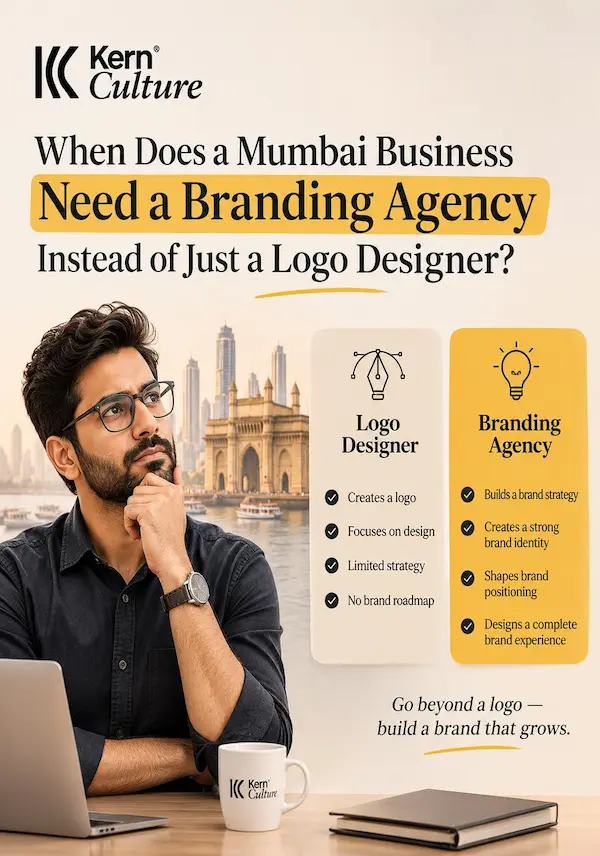
A business needs a branding agency in Mumbai rather than a logo designer when its problem is about how the business is understood, chosen and remembered, not only how it looks. If customers cannot tell you apart from competitors, your value is unclear, or you are launching, expanding or repositioning, a logo alone will not solve it. A logo designer is a sound choice when strategy is already settled and the need is a defined visual one.
A logo designer answers a visual question: what should this mark look like? A branding agency answers a business question first: who is this brand for, why should they choose it over the alternatives, and how should every part of the business express that choice? Logo design is one output of that thinking, not a substitute for it. For founders and growing businesses in Mumbai, where customers in many categories can compare several options within minutes, the gap between the two can decide whether a new identity changes how the business is perceived or only changes how its stationery looks.
This guide explains the difference, the situations where each option fits, and how to decide between them. It is not a guide to selecting an agency. It focuses on the earlier question: whether you need strategic branding at all.
Is a Logo Enough to Build a Strong Brand?
A logo does a specific job. It identifies the business, gives customers a quick way to recognise it, and provides a starting point for visual consistency. It also shapes a first impression, which is worth getting right.
What a logo cannot do on its own is more important. It cannot decide what the business stands for, explain to customers why they should care, or create brand differentiation in a category where competitors look and sound alike. It cannot fix a website that says one thing while the packaging says another, and it cannot set a voice for the people writing proposals, social posts and replies.
This is because customer perception is formed by experience, not by a mark. Customers judge the product, the price, the website, the packaging, the conversations and how problems are handled. A logo contributes to recognition only once it is attached to something worth recognising. That something is built through brand positioning, brand messaging and a coherent identity, which is where strategic branding begins.
What Is the Difference Between a Logo Designer and a Branding Agency?
The two differ in scope, in what they ask before they design, and in what you receive at the end.
| Criteria | Logo Designer | Branding Agency |
|---|---|---|
| Typical Scope | The logo, often with variations, and sometimes colour and typography. | Strategy through identity and application. |
| Strategic Input | Usually works from the client’s brief. | Helps define the brief through discovery and research. |
| Process | Concepts, revisions, and final files. | Discovery, research, positioning, messaging, identity, and guidelines. |
| Typical Deliverables | Logo files. | Brand strategy, positioning, messaging, identity system, and brand guidelines. |
| Best Suited To | A defined visual requirement. | A business challenge involving perception, differentiation, or growth. |
A logo designer may be entirely appropriate for a narrowly defined need, and nothing here suggests every business must hire a larger team. Some independent designers also offer strategic thinking, and some agencies take on narrow projects, so these labels describe typical scope rather than quality. If you are searching for a logo designer in Mumbai or a larger studio, the useful question is not the job title but what the engagement will actually cover.
Agency labels overlap too. A creative agency in Mumbai often leads with campaign ideas and communication. A design agency often leads with visual and digital execution. A branding agency typically leads with strategy and then connects it to identity and experience.
7 Signs Your Business Needs a Branding Agency
These signs describe business problems, not design preferences. Where an example appears, it is an illustrative scenario, not a client case.
1. Your Business Is Difficult to Differentiate From Competitors
The challenge here is that customers describe you in the same words they use for your competitors. When that happens, price tends to become the deciding factor, because nothing else separates the options.
This matters because business differentiation is what lets a customer prefer you for a reason other than discount. Strategic branding helps by starting with competitive analysis: mapping what the category says, how it looks, and what it leaves unsaid.
An illustrative scenario: a boutique skincare label whose packaging, claims and tone could be swapped with three competitors without anyone noticing. A new logo would change the mark but not the sameness. Differentiation work would begin by finding territory in the category that customers value and competitors are not credibly occupying.
2. Your Brand No Longer Reflects Your Business Direction
Businesses change faster than their identities. A company that began as a trading business and now sells its own products, or a services firm that has moved up-market, may still be presenting itself as it was at founding.
The risk is a gap between what the business is and what customers believe it is. Strategic branding helps by redefining brand purpose and positioning for the business as it now exists, and then updating identity to express that. Refreshing the logo without revisiting the strategy tends to leave the old perception in place.
3. Your Target Audience Does Not Understand Your Value
A common symptom is that sales conversations are spent explaining what you do, or enquiries arrive from people who are not a fit. The offer may be strong, but the value proposition is not reaching the right target audience in terms they recognise.
This matters because customers rarely invest effort to decode a brand. A branding engagement addresses it through customer research, an understanding of customer needs and expectations, and a messaging framework that states the value plainly. A logo has no way to carry that explanation.
4. Your Brand Identity Is Inconsistent Across Touchpoints
If your website, packaging, social media, proposals and printed material look like the work of different businesses, customers notice even if they cannot say why. Inconsistency usually comes from growth: each new need was handled by a different vendor, without a shared system.
The cost is weaker brand recognition and less trust. Strategic branding helps by building a visual identity system and brand guidelines so that teams and external partners apply the brand the same way. A logo designer who delivers files does not usually resolve this, because the issue is the absence of a system.
5. Your Business Is Launching a New Product or Entering a New Market
A new product raises a structural question: should it sit under the existing brand, alongside it, or as a separate brand? This is a question of brand architecture, and answering it badly can dilute the main brand or leave the new product without a clear identity.
A new market raises a different one. Customer expectations can differ by city, category and segment, so assumptions that worked in one market should be tested rather than carried over. A branding agency helps by examining the new competitive landscape and adapting positioning and messaging with deliberate choices.
6. Your Business Is Growing Beyond Its Original Identity
An identity built at the founding stage usually reflects one product, one audience and a small team. As the business adds offerings, people and channels, that identity may not stretch to cover them.
Signs include founders rewriting the same explanation for each audience, or new teams improvising their own look. Strategic branding helps by creating a flexible identity and design system that can grow without fragmenting, and by clarifying how the parts of the business relate to each other.
7. Your Marketing Looks Active, but Your Brand Positioning Remains Unclear
A business can post regularly, run campaigns and still struggle to be understood. The reason is often that marketing amplifies whatever message already exists. If the positioning is unclear, marketing spreads that lack of clarity more widely.
Branding and marketing do different jobs. Branding defines meaning and positioning, and marketing carries that meaning to customers. A branding agency can supply the positioning that gives campaigns something specific to say, which usually makes marketing decisions easier to evaluate.
When Should a Mumbai Startup Invest in Branding?
Early-stage businesses often assume branding can wait until revenue arrives. The better question is which decisions will be expensive to reverse. Name, positioning and core identity are hard to change once customers, partners and content have formed around them.
There are several natural moments to invest:
- Business launch: when the brand is first meeting customers and has no history to rely on.
- New product introduction: when a product needs its own identity or a clear place within the existing brand.
- Positioning and differentiation: when the category already has established options and a new entrant must give customers a reason to notice it.
- Business expansion: when the brand must work in new cities, channels or audience segments.
- Repositioning: when the business has outgrown how it is currently perceived.
- Moving from founder-led selling to a recognisable brand: when early customers came through the founder’s personal relationships, and growth now depends on the brand explaining itself without the founder in the room.
Mumbai’s business ecosystem includes founder-led trading and manufacturing firms, services businesses, and consumer and D2C startups, and each faces a different version of this question. A D2C brand competes largely on how it presents itself online and on its packaging experience. A services firm competes more on credibility and clarity in conversations. Business stage matters too. A startup with limited resources does not need everything at once, so branding scope can be staged, with strategy and core identity first and wider applications later. The same reasoning applies to small businesses, where a focused engagement on positioning and identity often makes more sense than a full programme.
Businesses planning to grow beyond Mumbai should think about portability early. Our perspective on working as a branding agency in India covers how a brand built in one city can be prepared to travel.
When Is Hiring a Logo Designer Enough?
A logo designer is the right choice in several honest situations:
- Established positioning: your strategy is documented and understood, and you only need the visual mark to catch up.
- Existing identity system: you already have guidelines, typography and colour, and need a refined or modernised mark within them.
- A specific design requirement: a sub-brand lockup within an existing system, an event mark, or a defined one-off need.
- A very early test: you are validating an idea and want something simple before committing to a larger investment.
Even then, results improve when the designer receives a written statement of who the business serves and how it wants to be perceived. A logo briefed with clear strategy tends to be better than one briefed with taste alone.
If the need extends from a logo to packaging, a website or a wider visual system, a design agency in Mumbai may be the right middle option. The deciding factor is whether the strategy behind the design is already clear. If it is, execution may be all you need. If it is not, design alone will be working without a brief.
What Does a Branding Agency in Mumbai Actually Do?
A branding agency connects business strategy to how customers perceive and experience the brand. In practice, the work covers several connected areas:
- Business understanding: objectives, business model, founder vision, products and the commercial problem the brand must help solve.
- Research: customer research, review of the target audience, and competitive analysis.
- Strategy and positioning: defining the value proposition, the brand’s place in the category and the basis of differentiation.
- Messaging: brand narrative, brand voice, tone of voice and key messages.
- Identity: logo, typography, colour, imagery and the system that holds them together.
- Brand experience: applying the brand to the website, packaging, communication and other touchpoints.
Firms describe themselves in different ways. Some present as a brand strategy agency, others as a brand identity agency, and many cover both, sometimes as a branding and design agency in Mumbai. An independent branding consultant may focus mainly on the strategic layer. Because terms are used loosely, it is worth asking what a given provider actually delivers within brand strategy services.
For a closer look at how this engagement is structured, see Kern Culture’s overview of its strategic branding agency services.
How Brand Strategy Shapes Positioning and Differentiation
Strategy is the stage that makes design decisions defensible. It begins with audience understanding: who the customer is, what they need, what they expect from the category, and how they currently see the business. It then looks at the competitive landscape to see where brands cluster and where meaningful space remains.
From there, the work defines the value proposition, the specific benefit offered to a specific customer, and the brand positioning, which is the place the brand should occupy in the customer’s mind. Brand personality gives that position a human character, which later guides tone and imagery. Differentiation comes from the combination: a position that customers value, that fits the business honestly, and that competitors cannot easily claim.
The order matters. If identity is designed before positioning is set, the visual work tends to be justified afterwards. If positioning comes first, each design decision can be tested against it. For a deeper explanation of this stage, see Kern Culture’s guide to brand positioning strategy.
How Brand Identity Turns Strategy Into a Recognisable System
Brand identity is the sensory expression of the strategy. It typically includes the logo, typography, a colour system, photography and imagery style, packaging, and the brand guidelines that document how everything is used. Together these form a visual identity system.
These elements should work together because customers experience them together. A distinctive logo set against generic typography and stock-style photography will read as inconsistent. A packaging system that does not match the website will weaken recognition. A system approach defines which elements stay fixed, such as the mark and core colours, and which can flex, such as layouts and imagery, so the brand stays recognisable across formats.
The principle is that identity should express the strategy rather than replace it. Guidelines then keep that expression coherent as more people use the brand.
How Consistent Brand Experiences Build Recognition and Trust
Customers meet a brand across many brand touchpoints: the website and digital experience, packaging, social media, sales materials, customer conversations and, for some businesses, physical retail. Each is an opportunity to confirm or contradict the brand’s promise.
Brand recognition grows through repeated, coherent exposure, and trust grows when what customers experience matches what the brand has said. A polished website followed by a careless onboarding process teaches customers that the polish was surface-level.
Consistency does not mean every touchpoint looks identical. A social post, a product label and a proposal can differ in format and still feel unmistakably like one brand because they share the same logic, voice and values. The aim is coherence, and guidelines exist to make that logic explicit to anyone who applies the brand.
Strong brand experiences also help businesses build meaningful relationships with their audiences. Through consistent messaging, distinctive positioning and relevant customer experiences, a brand can become more recognisable and memorable. Explore how a branding agency builds brands that connect with customers to understand how strategic branding can strengthen the relationship between a business and its audience.Real-World Example: How Omara’s Brand Strategy Went Beyond Visual Design
Omara is a fine jewellery brand and a project Kern Culture has worked on from 2024 to the present. The services involved were Brand Strategy, Go-to-Market, Identity Design and Creative Direction. The account below describes strategy and execution, not commercial results, and it makes no performance claims.
The Challenge: Creating a Distinctive Fine Jewellery Brand
The project began with a clear problem: creating a distinctive identity in a saturated market. In a category where customers already have many options and established expectations, a new brand cannot rely on describing its products alone. It needs a reason to be remembered that goes beyond the product itself.
This is the situation where a logo on its own would not have been enough. A well-drawn mark would have identified the brand, but it would not have told customers what the brand meant or why it was different from the others.
The Strategic Idea: Adornment as Victory
The strategic idea was “adornment as victory.” Instead of treating jewellery purely as decoration, the idea frames it as a way of marking a personal win. It gives the brand a point of view about what the product means to the person wearing it.
A single idea like this is useful because it works as a reference for decisions. When a team has to choose a name for a collection, a packaging approach or a launch concept, it can test each option against the idea.
Translating the Strategy Into Identity, Packaging, and Go-to-Market
The idea informed the brand narrative, the logo, the packaging, the wider identity and the go-to-market approach. That range is the practical value of strategy-led work: one idea gives otherwise separate decisions a shared reference, so the brand can feel coherent across a mark, a box and a launch plan.
It also shows why the creative direction and go-to-market work belonged inside the same engagement as identity. The way a brand reaches customers is part of what it communicates.
What Businesses Can Learn From the Omara Project
Four lessons apply well beyond jewellery:
- Differentiation starts with an idea, not a style. A distinctive look can be copied. A clear idea about meaning is harder to copy.
- Strategy extends past identity. Go-to-market decisions shape perception as much as visual design does.
- A logo is one expression of the brand. It carries the idea but does not create it.
- Brands develop over time. The project is ongoing, which reflects how brands are built through sustained decisions rather than a single delivery.
What Should Mumbai Businesses Consider Before Hiring a Branding Agency?
Before approaching any agency, a few internal questions help you decide what kind of support you need.
Business objectives. What should branding help the business achieve: entering a new market, raising perceived value, attracting a different customer? Without an objective, it is difficult to judge whether the work succeeded.
Target customers. Who do you need to convince, and what do you know about them? Businesses that sell to other businesses, to consumers or through intermediaries face different decisions about tone, channels and proof.
Category competition. How crowded is your category, and how similar are the players? In heavily contested categories, differentiation work carries more weight. In less contested ones, clarity and consistency may matter more.
Strategic process. Does the agency ask about your business before proposing design? A process that begins with discovery is a better indicator than one that begins with concepts.
Relevant portfolio evidence. Look for work that shows reasoning, not only finished visuals. Ask how decisions were made and what problem they solved.
Collaboration style. Branding involves founder-level decisions, so consider how an agency handles disagreement, feedback and approvals.
Deliverables. Clarify what you will receive: strategy documents, identity files, guidelines, templates, application designs.
Budget transparency. Ask for a scoped proposal and what is and is not included. Costs vary with scope, so comparisons only make sense between like-for-like proposals.
How to Evaluate Branding Agencies in Mumbai
When comparing branding agencies in Mumbai, the clearest signal is whether an agency can explain its reasoning. Strong candidates can show how a strategic insight led to a design decision and describe the trade-offs involved.
A practical evaluation looks at:
- Strategic thinking: can they define your problem before offering solutions?
- Discovery and research: how will they learn about your customers and competitors?
- Positioning expertise: can they show how positioning was developed on past work?
- Connection between strategy and design: do visual choices trace back to a stated idea?
- Relevant project experience: have they handled comparable challenges, even in a different sector?
- Communication: are they clear, responsive and honest about limits?
- Project scope: is it precise about deliverables, timelines and what sits outside the engagement?
No ranking is implied here. The right agency is the one whose approach fits your problem and whose reasoning you can follow.
What Should You Expect From a Branding Agency’s Process?
Processes and deliverables vary by agency and project, but a thorough engagement usually follows this logic:
- Discovery: the agency learns the business, its objectives and its constraints.
- Business and customer understanding: it examines how customers think, decide and perceive the business today.
- Research and competitive analysis: it maps the category to see where brands cluster and where room exists.
- Brand positioning: it decides where the brand should sit in the customer’s mind.
- Brand strategy: it sets the value proposition, personality and messaging direction that follow from the positioning.
- Brand identity development: it gives the strategy visual and verbal form.
- Brand applications: it tests the identity on real touchpoints such as packaging, digital and print.
- Implementation and rollout: it supports launch, documents the system in guidelines and helps teams apply it.
Each stage constrains the next. Skipping research produces generic strategy, and skipping strategy produces decorative identity.
What Questions Should You Ask Before Choosing a Branding Partner?
- Business understanding: what would you need to learn about our business before recommending anything?
- Strategic reasoning: can you walk me through a past decision, from the problem to the final design?
- Research process: how do you study customers and competitors on a project of this size?
- Deliverables: exactly what will we receive, and in what formats?
- Ownership and handover: who owns the final assets, and are source files and guidelines handed over?
- Timelines: what affects the schedule, and what do you need from us to keep it on track?
- Revisions: how are feedback rounds structured, and what happens if the direction changes?
- Implementation: do you support rollout, or does the engagement end at delivery?
- Evaluation of project outcomes: how do we judge whether the branding is working, and what is realistic to expect?
An agency that answers these openly, including admitting what it cannot promise, is usually easier to work with.
Branding Agency vs Logo Designer: Which Is Right for Your Business?
Use your situation, not the label, to decide.
| Your Situation | Likely Fit |
|---|---|
| Positioning is clear and documented, and you need a specific mark or a refinement. | Logo designer |
| Strategy is settled, but you need packaging, a website or a full visual system. | Design agency or visual identity engagement |
| Customers do not understand your value, or you look like your competitors. | Branding agency |
| You are launching, repositioning or expanding into a new market. | Branding agency |
| Your identity is inconsistent across touchpoints. | Visual identity system, often with a brand strategy review |
| Your marketing is active but your message is unclear. | Branding agency, starting with positioning |
If you are unsure, the checklist later in this guide helps you assess where your business stands. A practical rule: if the problem is how the business looks, a designer may be enough. If the problem is how the business is understood, strategy needs to come first.
How Kern Culture Approaches Strategic Branding
Kern Culture is a strategic branding and design consultancy based in Mumbai that works with founders, startups, growing businesses and established organisations. Its work spans brand strategy, brand positioning, brand identity, visual identity systems, creative direction, packaging design, website design, brand experience, go-to-market strategy and brand guidelines.
Its approach is built on two ideas. Frame represents strategic structure: the positioning, messaging and systems that give a brand a stable foundation. Flow represents the dynamic conversation between a brand and culture: how customers, markets and expectations change, and how a brand stays relevant within that movement.
The two work together. Structure without that conversation can become rigid, and responsiveness without structure can become inconsistent. The aim is a brand that has a clear core and can still adapt. The Omara project reflects this link between strategy and design: the strategic idea shaped the narrative, identity, packaging and go-to-market in one connected effort.
Conclusion: Choose the Right Level of Branding for Your Business
The central distinction is simple. A logo designer solves a visual need, while a branding agency solves a perception and positioning problem and then expresses the answer visually. Neither is better in general. The right choice depends on whether your challenge is about how the business looks or how it is understood.
If customers cannot tell you apart from competitors, do not grasp your value, or your brand is struggling to keep up with a launch, expansion or repositioning, strategic branding is likely to be worth the investment. If your positioning is clear and you need a defined piece of design, a logo designer or design specialist may be all you need.
If your situation falls on the strategic side, you can explore Kern Culture’s Branding Agency in Mumbai page to see how the engagement works. You can also visit the Kern Culture for more of the studio’s work.
FAQs
Q1. When does a business need a branding agency?
A: A business needs a branding agency when its challenge involves perception, positioning or growth, not only visual design. Typical triggers include looking similar to competitors, customers not understanding your value, a launch or new market, repositioning, rapid growth, or inconsistent communication across touchpoints.
Q2. What is the difference between a branding agency and a logo designer?
A: A logo designer typically creates the logo, while a branding agency typically defines strategy, positioning, messaging and identity, and then applies them across touchpoints. Roles overlap in practice, so ask any provider what its engagement actually covers.
Q3. Is a logo enough to build a strong brand?
A: Usually not on its own. A logo helps customers identify and recognise a business, but it cannot define what the business stands for, differentiate it from competitors or shape the customer experience. A strong brand combines positioning, messaging, identity and consistent experience.
Q4. What does a branding agency in Mumbai do?
A: A branding agency in Mumbai helps a business understand its customers and competitive landscape, define its positioning and messaging, and develop an identity that expresses that strategy. Many also guide how the brand is applied to packaging, websites and other touchpoints, and document the system in brand guidelines.
Q5. Why should a business hire a branding agency?
A: A business should hire a branding agency when it needs strategic clarity and a coherent identity that an internal team or a single designer cannot easily provide. An agency brings structured research, positioning and a system that holds the brand together across channels and over time.
Q6. When should a startup invest in branding?
A: Ideally before or at launch, when decisions about name, positioning and core identity are still easy to shape. A startup can also invest when introducing a new product, entering a new market, or moving from founder-led selling to a brand that explains itself. Scope can be staged to fit available resources.
Q7. Can a small business benefit from a branding agency?
A: Yes, particularly when it needs to stand out in a competitive category or its message is unclear. A small business does not need a large programme. A focused engagement on positioning and core identity can be a sensible starting point, with further applications added as the business grows.
Q8. What services do branding agencies in Mumbai offer?
A: Services vary by agency, but commonly include brand strategy, positioning, messaging, logo and visual identity design, packaging design, website design, creative direction, brand guidelines and go-to-market support. Check each agency’s scope, since some focus on strategy and others on design.
Q9. How do I know if my business needs rebranding?
A: Common signs include an identity that no longer reflects what the business does, customers misunderstanding your value, inconsistent communication, or a move into new audiences or markets. A rebrand is not always a full redesign. Sometimes refining positioning and messaging is enough.
Q10. What is included in a brand strategy?
A: A brand strategy typically covers business objectives, target audience, customer needs, competitive analysis, value proposition, brand positioning, brand personality and messaging direction. Exact contents vary by agency and project, so ask for a clear outline before you commit.
Q11. How does brand positioning help a business stand out?
A: Brand positioning defines where a brand sits in the customer’s mind relative to alternatives. A clear position gives customers a reason to choose the brand and gives the business a consistent reference for messaging, design and communication decisions.
Q12. How long does a branding project typically take?
A: There is no single timeline. Duration depends on the scope of work, the depth of research, the complexity of the business and category, how many people are involved in decisions, the number of identity applications, and how quickly feedback is given. Ask an agency for a schedule tied to your specific scope and what could extend it.
Q13. How much does it cost to hire a branding agency in Mumbai?
A: Cost varies and cannot be stated as one figure. It depends on the scope (strategy only or strategy plus identity and rollout), the size and complexity of the business, the level of research, the number of deliverables, the seniority of the team and the implementation support required. Request a scoped proposal and confirm what is included.
Q14. What should I check before choosing a branding agency?
A: Check whether the agency can explain its strategic thinking, describe its discovery process, justify design decisions with reasoning and show relevant project experience. Also confirm deliverables, asset ownership, timelines, revision terms and how it handles collaboration with your team.
Q15. Can a branding agency help create a consistent brand identity?
A: Yes. A branding agency can build a visual identity system covering logo, typography, colour, imagery and packaging, and document the rules in brand guidelines. These help teams and vendors apply the brand the same way across channels, which supports recognition and trust.
Q16. Should I hire a branding agency before launching a new business?
A: Often it helps, because positioning, naming and identity are easier to set before customers form impressions. It is not essential for every launch. If resources are tight, a staged approach covering strategy and core identity first can be a practical middle path.
BRANDING DECISION CHECKLIST
Answer each statement with yes or no. Then use the reading guide below.
Section A: Do you need a standalone logo designer?
- My positioning is clear, documented and understood by my team.
- I already have brand guidelines, colour and typography in place.
- My need is a specific mark, a refinement or a defined one-off design.
- My customers already understand and value what I offer.
Section B: Do you need a visual identity system?
- My website, packaging, social media and sales materials look inconsistent.
- Different vendors or team members apply the brand differently.
- My logo works, but nothing supports it across touchpoints.
- My strategy is clear, but my visual expression does not reflect it.
Section C: Do you need a complete strategic branding engagement?
- Customers struggle to tell me apart from competitors.
- My audience does not clearly understand my value.
- I am launching a product, entering a new market, or repositioning.
- My business has outgrown its original identity.
- My marketing is active, but my message is unclear.
- I have not yet defined who the brand is for and how it should be perceived.
How to read your answers:
- Mostly yes in Section A: a logo designer is likely enough.
- Mostly yes in Section B, with a clear strategy: a visual identity system is likely the right scope.
- Several yes answers in Section C: begin with strategy and positioning, then move to identity.
- Yes answers across sections: start with strategy, because it affects the other two.
HOW WE DEVELOPED THIS GUIDE
This guide is structured around practical branding decisions a business faces when choosing between a logo designer and a branding agency. It draws on general professional understanding of brand strategy, positioning and identity, on business considerations such as stage, category and growth plans, and on verified project experience from Kern Culture’s Omara work.
No independent research, interviews, surveys or testing was conducted for this article, and it does not cite external statistics. The scenarios in the seven signs are illustrative, not client cases. Descriptions of how agencies typically work reflect common professional practice, and individual agencies and projects differ.
ABOUT THE AUTHOR
Shriya Nagi is Founder & Chief Brand Strategist at Kern Culture, a strategic branding and design consultancy based in Mumbai. More information about the studio is available on the Kern Culture company.