

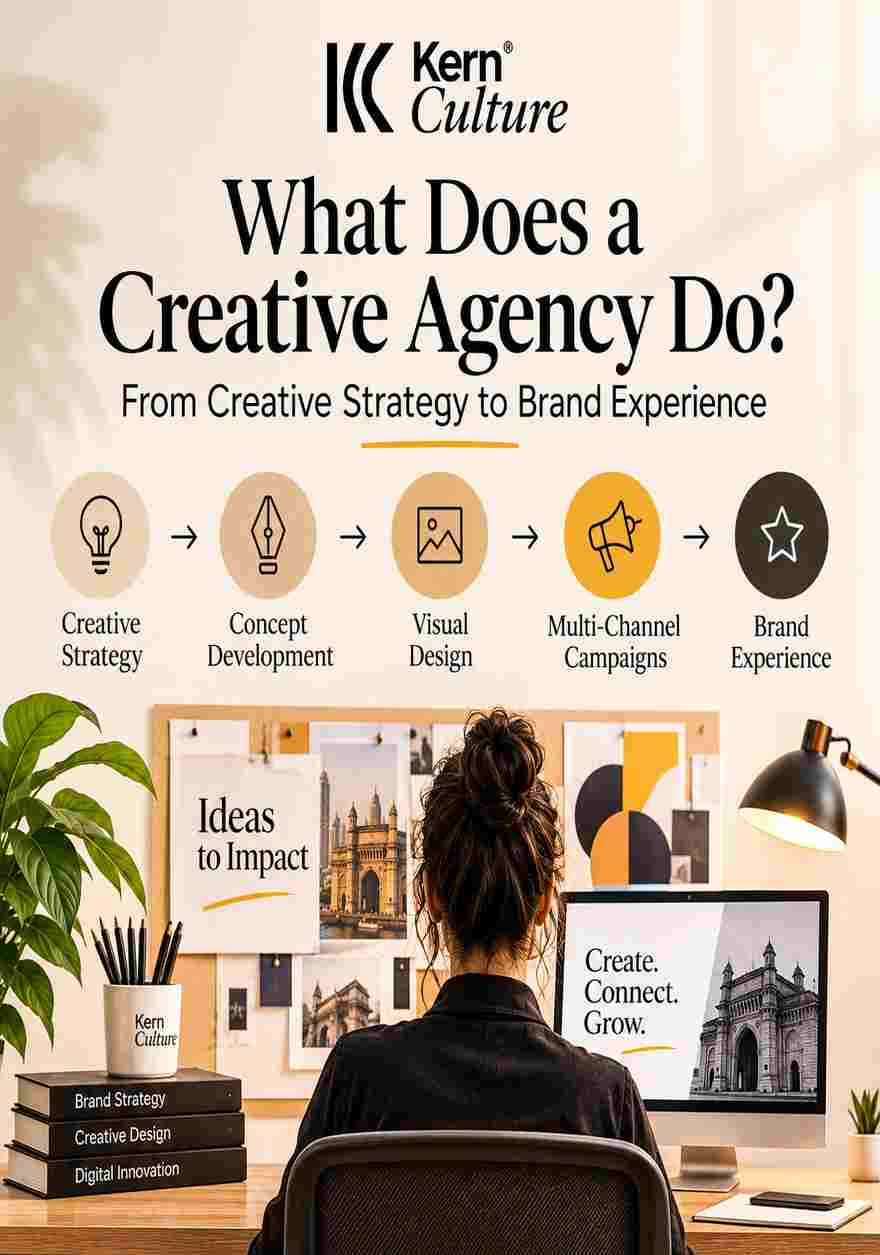
Understanding What a Creative Agency Does
Most businesses meet a creative agency through its output: a logo, a campaign, a website. Because the output is visible, it is easy to assume the work is mainly about making things look good. In practice, the visible work is the last step in a chain of decisions about what a business wants to achieve, who it needs to reach, what those people expect, and how the brand should be understood.
A creative agency works through that chain. Creative strategy, brand positioning, creative direction, design and brand experience are not separate services in this view. They are stages of one process, and a weakness in an early stage shows up as a weakness in every later one. For founders and growing businesses in Mumbai, where a brand often competes for attention with many credible alternatives, that connection matters.
This guide explains what a creative agency does, which services it offers, how creative strategy works, and how a creative agency differs from a branding agency or a design agency. It also shows the thinking at work in a real project.
What Does a Creative Agency Do?
A creative agency helps businesses develop and communicate ideas through creative strategy, brand storytelling, design, visual identity and brand experiences. It connects business objectives with audience expectations to create meaningful and consistent brand communication.
These capabilities depend on each other. Creative strategy decides what the business should say and why. Brand storytelling gives that message a narrative. Design and visual identity give it a recognisable form, and brand experiences carry it to customers at each point of contact. If the strategy is unclear, design has nothing to express. If the design is weak, a good strategy never reaches the customer.
What Is a Creative Agency?
A creative agency uses creative thinking to solve communication and brand problems for other businesses. Its purpose is to help an organisation decide what to say, to whom, and in what form, and then to produce the work that carries that message.
The useful distinction is between creative execution and strategic creative thinking. Creative execution is the skill of producing a well-made asset, such as a layout, a pack or a web page. Strategic creative thinking comes earlier. It asks why the asset should exist, what it must change in the customer’s mind, and how it connects to business objectives. Execution without strategy can produce attractive work that solves nothing. Strategy without execution produces clear thinking that never becomes tangible.
Creative agencies sit between the two. They translate a business objective, such as entering a new category or changing how a product is perceived, into an idea, and then into communication that audiences recognise and remember.
What Services Does a Creative Agency Offer?
Services vary between agencies, but these seven are common. Each is described by its purpose, so that it does not repeat the general role above.
Creative Strategy
Creative strategy defines the problem to be solved, the audience to be reached and the central idea that will guide the work. It is most useful when a business has many possible messages and no clear priority among them.
Brand Strategy and Positioning
This work decides where the brand sits relative to alternatives: who it is for, what it stands for and why it is different. Without it, creative work has nothing to stay consistent with. Kern Culture describes its own approach on its branding agency services .
Creative Direction
Creative direction keeps visual and verbal output coherent. It sets standards for tone, imagery and art direction so that work produced by different people, vendors and formats still feels like one brand.
Brand Identity and Visual Systems
A brand identity includes the logo, typography, colour systems, photography style and graphic language, organised into a design system. The aim is a system that others can apply correctly, not a single mark.
Packaging and Communication Design
Packaging, print collateral and presentations are often where customers first judge a product physically. Packaging design is frequently the point at which a brand idea meets a shelf or a doorstep.
Website and Digital Experiences
For many businesses, the website is the first serious encounter with the brand. Its structure, language and digital design should express the positioning, not simply display information.
Brand Campaigns and Storytelling
Campaigns turn positioning into narrative. Brand storytelling gives audiences a reason to engage, and a campaign built on a clear position is easier to recognise and evaluate than one built on a clever line alone.
How Does Creative Strategy Turn Business Ideas Into Meaningful Brand Experiences?
Creative strategy moves from business needs to customer experience in six practical steps.
- Understand business objectives. The agency asks what the business needs: entry into a category, a premium position, a clearer story for investors. Objectives decide what counts as good work.
- Identify the target audience and its expectations. Customer expectations shape what will feel credible. A first-time buyer and a repeat buyer may need different reassurance.
- Research the competitive landscape. Competitor analysis shows which codes the category shares, where brands look and sound alike, and where meaningful space remains.
- Develop a distinctive creative direction. The agency forms an idea that is relevant to the audience, honest to the business and different from competitors.
- Translate strategy into creative expression. The idea becomes identity, messaging, packaging, web design and communication.
- Maintain consistency across brand touchpoints. Customers form perceptions across the whole customer journey, so the idea must hold from first impression to after-sales contact.
The sequence follows the relationship: business objectives, audience understanding, market research, creative strategy, brand positioning, creative direction, identity, design and communication, brand experience, and finally customer perception.
What Is the Difference Between a Creative Agency, Branding Agency and Design Agency?
| Agency Type | Primary Focus |
|---|---|
| Creative Agency | Creative thinking, concepts, communication and brand experiences. |
| Branding Agency | Brand strategy, positioning, identity and brand systems. |
| Design Agency | Visual communication, design solutions and digital or physical experiences. |
These categories overlap, and many firms work across all three. A branding agency still designs, and a design agency may contribute strategy. The labels describe where an agency usually starts, not the limit of what it does. A business that needs positioning and identity may look at a branding agency in Mumbai, while one that mainly needs visual and digital execution may begin with a design agency in Mumbai. A creative agency usually adds the idea and communication layer on top of both.
When Should a Business Hire a Creative Agency?
The strongest reasons are practical business problems, not a wish for better visuals.
- Launching a new business or brand: early decisions on positioning and identity are hard to reverse once customers have formed impressions.
- Entering a competitive market: a new entrant needs a reason to be noticed that established brands do not already own.
- Repositioning an existing brand: the business has changed, but customer perception has not.
- Developing a new product or service: it needs a clear role, name or identity relative to the existing brand.
- Improving inconsistent communication: different teams or vendors present the business in different ways.
- Creating distinctive customer experiences: the product is sound, but the experience around it feels generic.
- Expanding into new markets: expectations differ by audience and category, so assumptions need testing.
A business with a clear direction and a defined design task may not need a full creative engagement. The checklist later in this guide helps with that judgement.
How Can a Creative Agency Help a Business Stand Out in a Competitive Market?
Standing out depends on meaningful differentiation, not novelty. A distinctive colour is easy to copy. A clear idea about what the business means to its customer is much harder to copy.
Consider an illustrative example, not a client case: a packaged-food brand whose product is genuinely better than competitors, but whose pack looks like every other in the aisle. An agency would first identify the difference customers actually care about, such as craft or sourcing. It would then build a narrative around that strength, express it through a distinctive visual language, and apply it to packaging, website and social media so that each reinforces the last. Each creative decision is tested against the business objective: does it help the right customer understand why this product is different?
The Omara project below shows the same logic on a real brand. In both cases, creativity helps a business grow only when it clarifies something customers value, and consistency makes that clarity memorable.
Why Do Businesses Need a Creative Agency in Mumbai?
Mumbai’s business ecosystem includes finance, media, consumer goods, professional services, technology and a steady flow of startups. In many of these categories a customer can compare several options quickly, so a brand has to be understood early. A creative agency in Mumbai helps by making that first understanding clear and distinct.
Customer expectations also differ across segments. A premium consumer brand, a founder-led services firm and a D2C startup address different audiences, in different tones, through different channels. Local context matters: the visual standards of a category, the signals of credibility that buyers look for, and how customers actually discover and compare brands. Creative strategy should reflect these realities, and the wider Indian market, rather than borrow a template from elsewhere. This guide does not cite market statistics, because the aim is to explain the role, not to measure the city.
For a service-level view, see Kern Culture’s Creative Agency Mumbai. Businesses planning to grow beyond one city can read about its creative agency work across India.
What Should Businesses Look for in a Creative Agency in Mumbai?
- Strategic thinking beyond visual execution: can the agency define the problem before proposing a look?
- Understanding of business objectives: does it ask about commercial goals?
- Quality and relevance of the portfolio: does the work show reasoning, not only finish?
- Demonstrable project experience: can it describe real decisions and constraints?
- Ability to explain the creative process: can you follow how an idea was reached?
- Consistency across brand touchpoints: does past work hold together across formats?
- Clear communication and collaboration: is it honest about scope and limits?
How Does a Creative Agency Approach a Project From Strategy to Execution?
A general industry process usually runs through seven stages:
- Discovery and business understanding.
- Research and audience understanding.
- Strategic direction.
- Concept development.
- Creative development and design.
- Implementation across relevant touchpoints.
- Evaluation and refinement.
This is a general description, and agencies differ. Kern Culture’s own process, as published on its company page, is called the Clarity Framework and has four steps. Diagnosis involves deep research into the business and its culture. Distillation turns that insight into a focused strategic idea. Design applies that idea only once the strategy is settled. The fourth step, which the company calls a strategic safety net, covers ongoing counsel beyond design. The two processes are similar in intent, but only the second is Kern Culture’s published method.
Real-World Example: How Strategic Thinking Shapes Brand Expression
Omara is a fine jewellery brand and a Kern Culture client from 2024 to the present. The services were Brand Strategy, Go-to-Market, Identity Design and Creative Direction. This account covers strategy and execution. It makes no claims about sales, growth or other measurable results.
Understanding the Brand Challenge
Omara was a new fine jewellery brand that needed a distinct identity in a market full of traditional ideas of luxury and beauty. The challenge was to move beyond the conventional language of adornment and speak to a more personal feeling.
Developing the Strategic Idea: Adornment as Victory
The idea was “adornment as victory”, which the case study also describes as personal triumph. Jewellery is positioned as a marker of personal achievement, aimed at a modern consumer who sees it as a sign of her own success. One clear idea then gave the team a test for later decisions.
Translating Strategy Into Brand Identity
The case study describes a logo that uses a peacock and a crown to symbolise triumph, along with packaging and in-store collateral shaped by the same idea. The brand narrative speaks of strength and achievement. The aim, as stated on the project page, was for the feeling of triumph to be present from the unboxing experience to the digital narrative.
Connecting Creative Direction With Go-to-Market Thinking
Creative direction was provided across all verticals so that the launch felt cohesive. Go-to-market work sat inside the same engagement because the way a brand reaches customers is part of what it communicates.
What Businesses Can Learn From the Omara Project
- Differentiation comes from an idea about meaning, not only from a visual style.
- A single idea can guide very different outputs, from a logo to a launch.
- Strategy and creative direction are most useful when they are connected from the start.
How Kern Culture Approaches Creative Strategy and Design
Kern Culture is a strategic branding and design consultancy based in Mumbai. Its company page states that strategy must precede expression, and it describes a commitment to intellectual rigour and honest counsel.
Frame: Creating Strategic Clarity
The Frame is the constant: the strategic foundation, including positioning, structure and clarity, that does not shift with every trend. It gives creative decisions something firm to be tested against.
Flow: Connecting Brands With Culture
The Flow is the dynamic conversation between a brand and its audience, and the wider culture. It keeps the brand relevant as customer behaviour and expectations change.
Connecting Strategy, Design and Brand Experience
An agency that manages only the Frame risks a rigid brand that is out of touch. One that manages only the Flow risks a brand that follows trends without direction. Together, they link brand positioning to identity and identity to experience. Founders can learn more about the team and its principles on the Kern Culture company.
What Questions Should Businesses Ask Before Working With a Creative Agency?
- How do you understand our business before developing creative concepts? The answer shows whether discovery comes before design.
- How do you approach creative strategy? It shows whether the agency has a method.
- How do you translate brand positioning into design? It reveals whether design choices can be explained.
- What does your creative process involve? It sets expectations about stages and your own involvement.
- How do you maintain consistency across brand touchpoints? It shows whether the agency thinks in systems.
- What deliverables should we expect from the engagement? It prevents misunderstandings about scope.
Conclusion: Choosing a Creative Agency That Connects Strategy With Experience
A creative agency does more than produce visuals. It connects business objectives to audience expectations through creative strategy, positioning, creative direction, design and brand experience, and the strength of each stage depends on the one before it. Strategic thinking matters because it gives creative direction a reason, which is what makes differentiation believable. When strategy, design and customer experience support each other, a business communicates its value more clearly and more consistently.
If your business is weighing these choices, Kern Culture works with founders, startups and growing organisations as a strategic partner. You can explore its creative agency in Mumbai to see how the work is structured.
Frequently Asked Questions
1. What does a creative agency do?
A creative agency helps businesses turn objectives into ideas and brand communication. It combines creative strategy, storytelling, design and brand experience so that a business can reach its audience clearly and consistently.
2. What is the main purpose of a creative agency?
Its main purpose is to connect what a business wants to achieve with what its audience expects. The agency does this by deciding what to say, how to say it and how the brand should be experienced.
3. What services does a creative agency provide?
Common services include creative strategy, brand positioning, creative direction, visual identity, packaging and communication design, website and digital design, and campaigns. Scope varies by agency, so ask what is included.
4. What is the difference between a creative agency and a branding agency?
A creative agency usually centres on ideas, communication and experiences, while a branding agency usually centres on strategy, positioning and identity systems. The two overlap, and many firms do both.
5. What is the difference between a creative agency and a design agency?
A design agency typically focuses on visual and experiential execution. A creative agency typically adds the strategic and conceptual layer that decides what the design should express.
6. Why does a business need a creative agency?
A business needs one when it must be understood more clearly, stand apart from competitors or communicate consistently, and lacks the strategic and creative capacity in-house. It is not necessary in every situation.
7. When should a startup hire a creative agency?
Ideally at or before launch, when positioning and identity are still easy to shape. Startups can also hire one for a new product, a new market or a shift from founder-led selling to a recognisable brand.
8. How can a creative agency help a business build its brand?
It defines how the brand should be perceived, then expresses that through messaging, identity and experience. It also helps keep the brand consistent as the business grows.
9. What does creative strategy mean?
Creative strategy is the thinking that decides the problem, the audience and the central idea before any design begins. It links creative work to business objectives so that the work has a purpose.
10. How does creative direction influence brand identity?
Creative direction sets the standards for tone, imagery and visual style. It ensures that the logo, packaging, website and communication feel like one brand, rather than separate pieces.
11. How can a creative agency help a business stand out?
By identifying a difference customers actually value, building a narrative around it and expressing it distinctively and consistently. Standing out depends on meaning, not only on appearance.
12. What should I look for in a creative agency in Mumbai?
Look for strategic thinking, an understanding of your objectives, relevant portfolio and project experience, and the ability to explain its process. Local context helps, but the quality of reasoning matters more than location.
13. How do creative agencies approach a new project?
Most begin with discovery and research, move to strategic direction and concept development, and then to design, implementation and refinement. Exact stages and timelines differ by agency and project scope.
14. Can a creative agency help with brand positioning?
Yes, though it depends on the agency. Some lead with strategy and positioning, while others focus on execution, so ask how positioning is developed before design starts.
15. What is the relationship between branding, design and brand experience?
Branding defines meaning and position, design gives that position a form, and brand experience is what customers actually encounter. Customer perception follows the experience, so the three need to align.
16. How do I choose the right creative agency for my business?
Start with your actual need: strategy, direction, design or a combination. Then compare agencies on reasoning, relevant experience, process clarity and collaboration. Fees vary with scope, team and depth of work, so request a customised proposal and confirm what it includes.
Creative Agency Decision Checklist
Answer yes or no to each question.
- Do we have a clear brand direction that our team can state in a few sentences?
- Can we explain what makes our business distinctive from competitors?
- Is our visual identity consistent across the website, packaging, social media and sales material?
- Does our communication feel coherent across customer touchpoints?
- Do we know who our target audience is and what they expect?
Reading your answers: If you answered no to the first two, you likely need creative strategy and positioning first. If those are clear but the third and fourth are not, creative direction and a design system may be enough. If all five are yes and you need a defined piece of work, design execution alone may suit you. Hiring an agency is not the answer in every situation.
How We Developed This Guide
This guide draws on creative strategy principles, branding and design knowledge, general industry understanding and Kern Culture’s project experience, mainly the Omara case study and the company’s published methodology. No original research, interviews or surveys were conducted, and no external statistics are cited. The packaged-food example is illustrative. Descriptions of how agencies typically work reflect common professional practice, and individual agencies differ.
About the Author
Shriya Nagi is Founder & Chief Brand Strategist at Kern Culture, a strategic branding and design consultancy in Mumbai. The company’s website states that she has over a decade of experience. Learn more on the Kern Culture company.